Blowflies
The Chemistry of DeathBlowflies are central to the novel’s treatment of decomposition as both a natural process and a forensic clock. Their arrival and development help David Hunter estimate how long a body has been exposed, while the traces left by their activity contribute to questions about where and when victims died.
Biology and Forensic Use
The novel places Blowflies within the wider sequence of decomposition: insects lay eggs on remains, larvae feed and later move away, and other organisms become more prominent as decay progresses. This activity returns organic matter to the natural cycle, making flies part of nature’s means of breaking it down. Their importance is not limited to that ecological role. Because different insects have different life cycles, their presence and development can help investigators estimate a body’s time since death.
At the site where Neil Yates and Sam Yates discover Sally Palmer, the insects’ activity also connects the remains to the surrounding vegetation. David explains that larvae can leave in an orderly trail and that the chemicals produced during decomposition can kill grass. In the hot, dry conditions of the summer, insect development and these environmental traces provide clues, though neither supplies an exact answer on its own.
Reading the Scene
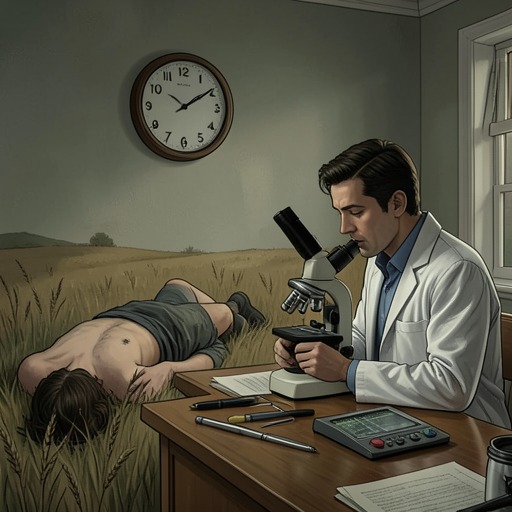
David Hunter treats insect development as a range of evidence rather than a precise clock. At Sally Palmer’s discovery site, he examines a larva nearing pupation: its darker color suggests it is seven or eight days old, while the absence of empty pupal cases means no flies have yet completed the full cycle. Since that cycle takes fourteen days, he first places the body within a preliminary interval of one to two weeks, then narrows his best estimate to about nine or ten days in the prevailing heat. The estimate remains provisional because temperature, daylight, wounds, and other conditions affect insect activity.
Other traces help test that estimate. David identifies adipocere, a soap-like substance formed as the body’s fatty acids break down, on the grass around Sally. Its brittle, crumbly state is consistent with rapid decomposition in hot weather, while the limited amount present also supports a period of less than two weeks. At a later animal carcass, he finds older larvae approaching emergence alongside a few beetles. Their appearance illustrates how the insect community changes as decay proceeds, but he cautions Mackenzie that beetles are less dependable indicators than maggots. The comparison therefore sharpens the inquiry without making its timing certain.
When another woman’s body is found, David again uses the condition of the remains and the amount of larval activity to estimate six or seven days in the consistent heat. The wounds resemble those on Sally, though they are fewer, and the body’s premature drying leads him to infer substantial blood loss before death. Soil at the discovery site has low iron content, which does not fit the quantity of blood expected there; David consequently suspects that she was killed elsewhere and brought to the site. The insects help establish an interval, but the contrast between the body and its surroundings raises a separate question about movement and the true location of death.
The Flies as a Narrative Presence
Blowflies are not only evidence to be interpreted; their presence also shapes how David Hunter experiences the scenes he examines. He acknowledges their forensic value and their essential role in breaking down organic matter, yet identifies their noise—not their appearance or their association with death—as the reason he hates them. As he approaches the marsh where another body has been found, the insects’ low, persistent drone becomes more noticeable, marking the scene before the remains themselves come into view.
That contrast gives the flies a double function in the investigation. Their life cycle offers David clues, but their sound resists being reduced to information: it is a recurring reminder that the forensic work takes place amid an active natural process, not outside it. The same creatures that help return the dead to the materials of life are, for the investigator, an unsettling presence that accompanies the search for an explanation.
Discovery and Narrative Function
The investigation begins not with a search party but with an ecological trace. In the second week of July, Neil Yates and Sam Yates were walking near Farnham Wood on their way to a swimming hole when Sam noticed a line of larvae in the grass. The brothers followed it toward its source, expecting the remains of an animal; instead, it led them to Sally Palmer. The trail makes the insects an inadvertent link between a hidden death and the living landscape, turning ordinary movement through the summer countryside into the discovery that draws David Hunter into the case.
The scene also establishes why Blowflies matter beyond any single estimate. Their activity makes decomposition legible, but only through signs that require interpretation: the trail points back to remains, while the insects’ development must be considered alongside weather, wounds, soil, and the possibility that a body was moved. Their role in the novel is therefore both biological and evidentiary. They transform decay into clues without making those clues self-explanatory, keeping forensic conclusions provisional even when the insects seem to offer a natural clock.